|
|
本帖最後由 Avantgarde-HK 於 2013-11-12 12:56 編輯
近日很多發燒友都問: Symposium Segue Platform 究竟是'嘜東東'. 表面看只是普通板一塊, 但原來內有乾坤. 我們特意請 Symposium Acoustics 佬板兼設計司 Mr. Peter Bizlewicz解釋一下. 原文如下:
The technology in the Segue is the same as is found in the Ultra Platform and Super Plus Platforms which we have been making for almost 20 years (actually, 2014 will be our 20th anniversary - it will be 20 years since we made and sold the first Super Platform in 1994. The first Ultra Platform was made in 1997). So, like Rollerblock Jr, the Segue is an inexpensive, affordable way for people to become introduced to our products. Of course, the platform will work better with a hard footer, like a cone or Rollerblock, etc. You should not use a rubber foot or sorbothane foot in between the component and the Segue platform (although some people will do this and will like it).
Constrained layer technology has been around for many years and is very effective. Our method is a little different from the usual because we make the different layers as varying densities - we call this "Ordered Layer Constrain Layer Technology," because we are placing the different constrained layers in a special ORDER of density going from higher to lower. That is, we start with a hard layer (aluminum) and each following layer is a little softer, until we get to the foam center section. This is called "mechanical impedance matching." Waves do not like to travel through layers of different density materials; they bounce or reflect back, like light that reflects back from the surface of water. Some gets through, but much of it reflects back. When you adjust the difference in the density of the neighboring layers and make less of a severe change of density, you can "trick" the wave to allow more of the energy to pass through, and have less reflect back. This is like climbing steps on a staircase, or on a ladder - if the steps are far apart, it is harder to climb, because the distance is greater between steps. But if the steps are closer together, it is easy to climb. It is the same principle with ordered layer constrained layer technology - there is less of a "difference" in the different layers, and wave energy can pass through more easily. This is how the Ultra, Super Plus, and Segue platforms work. At the same time, constrained layer technology is working to kill resonances, because when you bind two different materials together (constrained layer technology), you prevent each material from resonating. It is like tying two birds together - while each may be able to fly by themselves, if you were to tie two of them together, neither of them can fly! When one material is attached to another of similar but different density, each material damps the other material, and what you get is a structure that is acoustically neutral or "dead." This is what you want in a vibration control or isolation device. At the same time, the pathway for mechanical energy is from the hard layer to the softer (foam) layer. When the vibration gets into the foam, it is converted to heat energy, which is harmless to sound.
The ISO is the SAME as the Segue except for the footer spring suspension! I worked for years looking for an isolation system that will work to isolate turntables from low frequency shock and bass feedback problems, but all of the ones I tried damaged the sound quality. We tried sorbothane/rubber (which is what most companies use - it is terrible) AND also we tried magnetic suspension systems. The spring system, with some special air cell foam damping material inside of the spring, works the best. It does not damage the sense of dynamics and does not create any new, unwanted resonance, yet it protects the system from outside shock. The springs we use are very expensive! These are not cheap - these are special concentric stainless steel springs. They function like springs, but since they also come to a point, they also function like cones! So, you have both functions in one device - the cone AND the spring. The damping foam inside the spring takes away the spring's resonances and also damps the vertical compliance at the same time. I believe that, if you consider all of the aspects of this design, that this is a unique system that has never been seen before in the audio world.
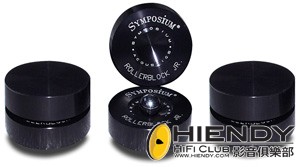
If you add a set of Rollerblock JR to the Segue ISO platform, you will have a true "6 Degrees of Freedom" isolation system. The Segue ISO provides the vertical wave isolation ("Z Axis Isolation"), while the Rollerblocks provide nearly perfect lateral wave isolation ("X and Y Axis Isolation"). Combined together, you get true X, Y, and Z axis isolation - for a price that is a FRACTION of what an active isolation table provides (most active isolation tables cost $5000 - $10,000). We are very proud of this, and hope that some day, some reviewer may appreciate it. Unfortunately, most USA reviewers and/or their magazine editors are not interested in reviewing vibration control equipment!
|
-

評分
-
4
查看全部評分
-
|



 IP卡
IP卡 狗仔卡
狗仔卡
 發表於 2013-11-12 12:39:09



 提升卡
提升卡 置頂卡
置頂卡 沉默卡
沉默卡 喧囂卡
喧囂卡 變色卡
變色卡 顯身卡
顯身卡
 發表於 2013-11-12 13:19:43